
New duties on 60 nations over forced labour claims raise legal, economic and geopolitical concerns
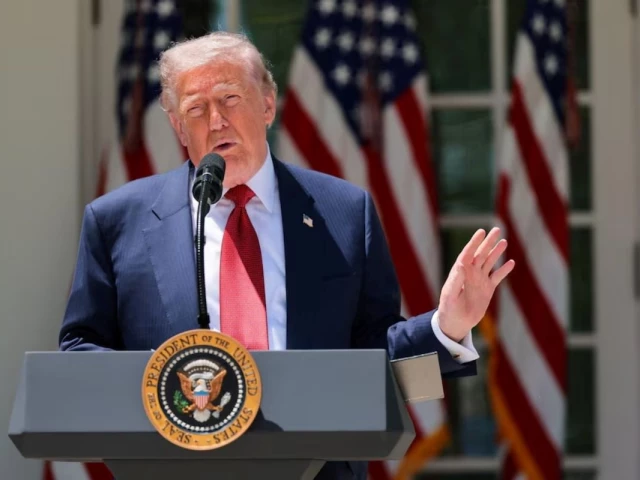
US President Donald Trump delivers remarks in the Rose Garden at the White House in Washington, DC, US, May 8, 2026. REUTERS
United States President Donald Trump’s administration has once again turned to tariffs as a central pillar of its trade policy, proposing sweeping new duties on imports from 60 countries over alleged failures to combat forced labour. While framed as a moral and economic corrective, the move is already provoking sharp international backlash and raising serious questions about its effectiveness — and its real intent.
Under the proposal, countries deemed to have partial restrictions on forced labour imports, including the European Union, Canada, Mexico and Pakistan, would face tariffs of 10%. Others, such as China, India and Australia, would be subject to higher duties of 12.5%, reflecting Washington’s view that they lack effective enforcement mechanisms altogether.
The Office of the US Trade Representative argues that these shortcomings create an “unlevel playing field”, forcing American workers to compete against goods produced under exploitative conditions. However, critics note that the policy casts an unusually wide net, targeting economies with vastly different legal frameworks and enforcement capabilities.
The tariff push came after a huge legal blow earlier this year, when the US Supreme Court ruled that Trump had exceeded his authority by imposing tariffs under emergency powers. In response, the administration has pivoted to Section 301 of the Trade Act of 1974 — a more established but slower mechanism — to justify the new measures.
This shift is widely seen as an attempt to rebuild Trump’s tariff regime ahead of the expiration of temporary Section 122 duties in July. While legally more durable, the move reinforces perceptions that the administration is determined to maintain tariff pressure regardless of judicial constraints.
The reaction from trading partners has been swift and unusually unified.
The European Union has dismissed the tariffs as unjustified, arguing that its upcoming Forced Labour Regulation — set to take effect in 2027 — will establish one of the most comprehensive bans globally. European officials have also warned that the new duties risk undermining ongoing negotiations aimed at stabilising transatlantic trade relations.
“Accusing the EU of not doing enough against forced labour is absurd. This looks very much like trying to make the facts fit a legal justification for tariffs that has already been decided,” said Bernd Lange, chair of the European Parliament’s trade committee.
China, facing the higher tariff tier, has also rejected the allegations outright. Officials in Beijing have accused Washington of politicising the issue, warning that escalating trade tensions will benefit no one and calling instead for dialogue based on mutual respect.
“China opposes all forms of unilateral tariff measures. There is no such thing as ‘forced labour’ in China,” said Mao Ning, China’s Foreign Ministry spokesperson.
Even close allies such as Australia have pushed back, insisting their domestic laws are robust and warning that the tariffs may violate existing trade agreements.
Prime Minister Anthony Albanese said: “The tariffs are unwarranted and would only push up prices for US consumers.”
Beyond diplomatic tensions, economists warn that the tariffs could have immediate and tangible economic consequences. New Zealand’s Trade Minister Todd McClay said: “This [new tariffs] is actually trying to find an actual legal base to put that tariff weight back in place.”
Singapore’s Ministry of Trade and Industry said there is no evidence linking the city-state to supply chains involving forced labour. “Forced labour is a transnational issue that requires international cooperation,” an MTI spokesperson said, adding that Singapore had conveyed its views during bilateral consultations with the USTR.
Analysts say alienating Singapore would be an unforced error — and perhaps a significant one. The city-state sits on a small island strategically located on the vital Strait of Malacca that connects the Indian and Pacific oceans, and it serves as a de facto security ally of the US. Singapore hosts and maintains US warships at its Changi Naval Base and participates in a range of other military agreements.
By increasing the cost of imported goods — ranging from agricultural products to industrial inputs — the measures are likely to drive up prices for American consumers already grappling with inflationary pressures. Businesses, particularly those reliant on global supply chains, may face higher costs and operational disruptions.
Analysts also caution that the broad scope of the tariffs could destabilise markets, particularly in Europe, where economies are already under strain from energy volatility and sluggish growth.
Perhaps the most fundamental question is whether the policy can achieve its stated goal.
Rights experts and trade specialists are deeply sceptical. They argue that tariffs calibrated by trade volume rather than the severity of labour abuses are unlikely to address the root causes of modern slavery. In some cases, they warn, the measures could even prove counterproductive by hardening political resistance in targeted countries.
Moreover, the global scale of forced labour — estimated by the International Labour Organisation at 27.6 million people — suggests that unilateral trade measures may be insufficient without coordinated international enforcement.
Critics increasingly see the forced-labour justification as a convenient legal and political vehicle for a broader protectionist agenda. Following multiple legal defeats, the Trump administration appears determined to reassert tariffs as a central economic tool — whether under the banner of national security, trade fairness, or now human rights.
This perception is reinforced by the inclusion of allies with strong labour protections, raising doubts about the consistency of the policy.
The tariffs are not yet final and remain subject to public consultation and hearings. However, the direction of travel is clear: the US is preparing for another phase of aggressive trade intervention. If implemented, the measures could reshape global trade flows, strain alliances, and deepen economic fragmentation at a time when cooperation is already under pressure.
Source link
