
Asia-Pacific economies explore new avenues for investment and technological cooperation as trade barriers mount
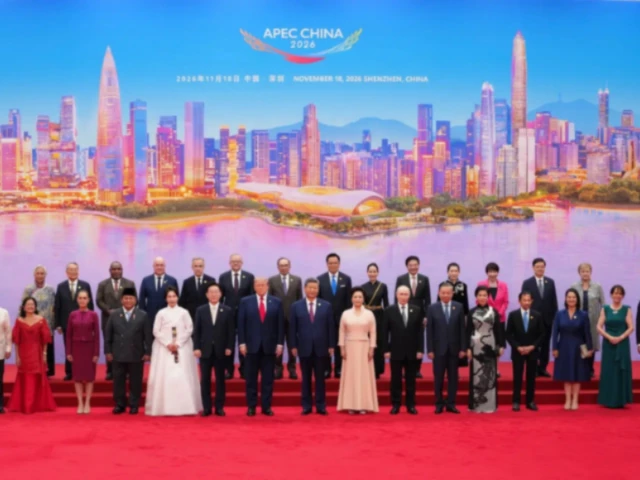
The 33rd APEC Economic Leaders’ Meeting is underway in Shenzhen, China, chaired by President Xi Jinping. Photo: APEC X handle
The 21 economies of the Asia-Pacific Economic Cooperation (APEC) forum produce more than 60 per cent of global GDP. They have vast consumer markets, dense manufacturing networks and fast-growing technology sectors, and many believe they remain underused as an engine of trade and investment.
This week, leaders met in Shenzhen for the 33rd APEC Economic Leaders' Meeting on November 18 and 19. The question was how to turn that potential into something businesses and workers can actually feel.
The numbers are encouraging. The APEC Policy Support Unit now expects the regional economy to grow 3.4 per cent in 2026, up from an earlier forecast of 3.2 per cent. Combined exports rose 22.5 per cent year-on-year in the first half of the year, against 6.5 per cent for the same period in 2025.
But growth in trade volumes is only part of the picture. Better connectivity, fewer regulatory hurdles, sturdier supply chains and wider access to new technologies will decide whether the momentum lasts.
APEC is unusual among international bodies. It runs on consensus and voluntary commitments rather than binding agreements, so economies with very different political systems and income levels can work together, each at its own pace. For more than three decades, that approach has kept regional leaders, policymakers and businesses talking.
This year's host programme has been busy: over 300 meetings in more than 10 Chinese cities, with around 10,000 participants, and another 10,000 have turned up during Leaders' Week.
Cutting the cost and complexity of trade is a central goal. Mismatched customs procedures, paperwork, regulations and digital systems still slow companies down, and small and medium-sized enterprises, which rarely have the staff to untangle them, feel it most.
China has proposed a connectivity framework running to 2035, covering infrastructure, regulatory efficiency, digital systems and the movement of people. If it delivers, transaction costs should fall and supply chains should become more predictable.
Artificial intelligence, digital services and advanced manufacturing are changing how things are made and sold, and APEC's ability to share expertise, attract investment and train skilled workers could shape how well its members adapt.
Business interest was visible at the APEC CEO Summit in Shenzhen, which drew more than 2,000 representatives from 21 member and 13 non-member economies.
Economist Jeffrey Sachs told the gathering that trade is not a zero-sum contest and that investment, joint ventures and technology exchange can benefit everyone involved. Jacob Cooke, chief executive of Canadian consultancy WPIC, pointed to China's open-source and open-weight AI models, which are increasingly affordable and accessible to firms elsewhere.
Others spoke of concrete partnerships. Rosario Navarro, president of Chile's business federation Sofofa, said Chilean companies want to cooperate with Chinese firms in high-tech fields, AI included.
Anindya Novyan Bakrie, who chairs Indonesia's Chamber of Commerce and Industry, highlighted talent development, industrial processing and technology transfer, and suggested closer ties between universities and business. He saw room for cooperation in critical minerals, agriculture and traditional energy.
Agriculture matters too. China is a major buyer of US soybeans, grains and almonds, and the US Soybean Export Council has voiced interest in wider market access. Taken together, these examples show that APEC's potential reaches well beyond finished goods, into investment, processing, technology transfer and regional supply chains.
The biggest obstacle may be rising protectionism. Tariffs, non-tariff barriers and unilateral measures raise costs and erode the predictability that long-term investment depends on. Business leaders at the summit warned that escalating restrictions could disrupt supply chains and shut firms out of markets. Low Kian Chuan, chairman of the Malaysia-China Business Council, said unilateralism and protectionism had pushed barriers and costs higher.
Martha Delgado, who leads APCO's operations for Mexico and Latin America, urged economies to stay open despite disputes over tariffs, trade restrictions and tighter borders. In her view, APEC members need to build their own capabilities while deepening regional integration if the Asia-Pacific is to remain a global economic centre.
The stakes are high because production is so intertwined. Components and raw materials often cross several borders before reaching a customer, so a restriction in one economy can ripple through manufacturers, suppliers and consumers across the region.
Other pressures are building. The Policy Support Unit expects inflation to reach 3.2 per cent in 2026, up 0.8 percentage points from 2025, driven largely by higher energy and electricity costs. And uneven access to AI infrastructure, investment and skilled labour risks concentrating the gains from innovation in richer economies and bigger companies.
APEC's consensus model keeps rivals at the table, but it also means the forum cannot compel anyone to change policy. Members differ widely in development, infrastructure, technological capacity and attitudes to trade, investment and energy security.
Even so, APEC's supporters argue that its value lies in managing those differences through sustained engagement. APEC Secretariat Executive Director Eduardo Pedrosa describes it as an ongoing process that keeps leaders and business communities in conversation.
Resilience is the theme of this year's discussions: stronger supply chains, more diverse investment and energy sources, better connectivity, and help for businesses and workers facing disruption. The bloc is also reviewing progress on its 2040 vision, set out in the Aotearoa Plan of Action, which aims to advance trade, innovation and inclusive growth.
Ultimately, Shenzhen will be judged on whether shared priorities become more efficient trade systems, stronger investment links and real opportunities for people. For a region under mounting protectionist pressure, the aim is not to erase differences but to stop them from undermining shared prosperity.
Source link
