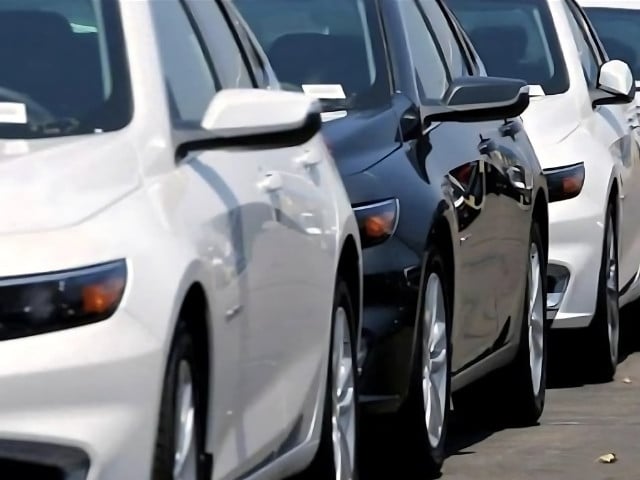

Chairman of the All Pakistan Motor Dealers Association (APMDA), Haji Muhammad Shehzad, expects the upcoming federal budget to offer major relief for used car buyers, including reduced import duties and an increase in the age limit for used cars from the current three years to five years.
Speaking exclusively to Express News, Shehzad said that this move is anticipated in line with Pakistan’s commitments under its agreement with the International Monetary Fund (IMF), in which the country agreed to gradually ease restrictions on car imports.
He stated that Pakistan has assured the IMF it will reduce the heavy duties and taxes on used cars over the next five years. These cuts will come either through lower sales tax or revised customs duties, according to Shehzad.
Currently, total duties on imported vehicles range from 96% to as high as 475%, but these will be gradually reduced by 20% annually over the next five years, he explained.
Read More: IMF slaps 11 new conditions on Pakistan
Tariff cuts, followed by an increase in the age limit of used cars to five years from three years, may slow down sales of locally made vehicles.
Used cars arriving under various schemes will further make deeper inroads, as cuts in tariffs on new and used vehicles will bring down prices of these vehicles.
The APMDA chairman also claimed that allowing the import of five-year-old cars, particularly on a commercial basis, could significantly lower vehicle prices.
He noted that a five-year-old Japanese car costs nearly half as much as a three-year-old model.
For instance, if a three-year-old vehicle is priced at $8,000, a five-year-old equivalent could be bought for $3,500 to $4,000. This could translate to a price drop of Rs 500,000 to Rs 1 million.
Shehzad said that if the proposed changes go through, the price of small cars could drop by as much as Rs 1 million.
He claimed the cheapest locally assembled car is currently priced at Rs 3.1 million, while a comparable model in a neighbouring country costs just Rs 375,000.
“Even after adjusting for the exchange rate, that car would cost around Rs 1.3 million here,” he said. With reduced duties and a relaxed age limit, he added, better-quality Japanese cars could be made available to Pakistani buyers for under Rs 2 million.
He further stated that if the government fully adheres to IMF conditions, used car imports in the next fiscal year could rise to 70,000–80,000 units, up from the current 30,000. This increase could also significantly boost government revenue by as much as 70%, he estimated.
According to Shehzad, the proposed reforms would not only make cars more affordable for the public but also challenge the monopoly of local assemblers.
This could push them to improve quality and move toward full-scale manufacturing. “There’s been no real localisation in Pakistan. We still rely on CKD kits.
If competition is introduced, local assemblers will be forced to improve. Removing duties and easing age limits on imports will drive market competition and ultimately strengthen the local auto industry,” he said.
Shehzad concluded by saying that if the IMF’s proposals are incorporated into the budget, it could prove to be a major and positive step for Pakistan’s auto sector, the public, and the government alike.
“People will have access to affordable, high-quality vehicles, the government will generate revenue, and local assemblers will need to upgrade to international standards.”
As discussions around structural reforms in Pakistan’s auto sector gain momentum, key industry stakeholders have weighed in on proposed policy changes tied to the IMF’s broader economic recommendations and the upcoming National Tariff Policy 2025–30.
Automobile sector consultant Shafiq Ahmed Shaikh views the IMF’s growing interest in the auto industry as a positive development, noting that it could help bring long-term solutions to the sector's challenges.
"It is a sensitive point, which must be discussed with the auto industry and other stakeholders for long-term and acceptable solutions," he said. "As we know, electric vehicles (EVs) are the future, which will mainly come from China, so it is the right time that sustainable and long-term policies and incentives for EVs and their accessories are introduced for better investments and more jobs."
Read More: Govt unveils major tariff reforms
Paapam differs on approach
On the other hand, Shehryar Qadir, Senior Vice Chairman of the Pakistan Association of Automotive Parts and Accessories Manufacturers (Paapam) and Executive Director at Jin Kwang JAZ Limited, has expressed serious concern over reports that the government may reduce peak customs duties on completely built units (CBUs) to 15% and bring duties on completely knocked down (CKD) kits even lower by 2030, as part of the National Tariff Policy 2025–30.
Read More: Auto parts makers decry new tariff policy
While the proposal is being positioned as a structural reform to boost export-led growth and meet IMF liberalisation targets, critics—including Paapam—warn it could lead to de-industrialisation and undermine decades of local investment in the auto industry.
Shehryar cautioned that such a move would severely weaken the competitiveness of domestic parts manufacturers, potentially pushing them out of their market.
A similar concern was echoed by Mashood Ali Khan, highlighting risks to the competitiveness of local parts manufacturers.
Meanwhile, Indus Motor CEO Ali Asghar Jamali has also called for revising the financing limit from Rs3 million to 70% of a vehicle's retail price and extending the financing tenure from three years to seven years.
It is good to encourage overseas Pakistanis to purchase locally manufactured vehicles by offering tax and duty exemptions, provided payments are made through foreign currency accounts. This will help shift demand away from used car imports.
He stressed the need for offering tax and duty breaks to vehicle exporters to ensure competitive international pricing.
Additionally, there is a need to sign free trade agreements and preferential trade agreements to enhance global competitiveness and market accessibility for Pakistani vehicles.
As far as used cars are concerned, the import of such cars should be restricted as it adversely impacts economic growth, fosters tax evasion, and fuels the grey market. Pakistan has an annual manufacturing capacity of 500,000 passenger vehicles, of which 76% remains underutilised.
There is an urgent need to keep a suitable tariff difference between completely knocked down (CKD) and completely built-up (CBU) units to incentivise local assembly, promote job creation, and support economic growth.
The government should develop a consistent and stable policy framework for the automotive sector to ensure long-term growth and avoid frequent policy changes.
This includes the formulation of a comprehensive policy to promote the establishment of local industries for essential raw materials such as steel, resin, aluminium, and copper, which are critical components for high-value goods.
For instance, India's steel policy has enabled it to become a net exporter of steel.
Jamali pleaded for rationalising the tax structure for locally manufactured vehicles to create a level playing field with the imported used cars.
He also called for adjusting the depreciation rate for the imported used cars from 1% to 0.5% to enhance tax revenue for the government.
Last week, auto industry stakeholders met with Special Assistant to the Prime Minister on Industries, Haroon Akhtar Khan, to discuss tariff-related concerns.
Although automakers have committed in previous policies to fully localise auto parts production through a 100% deletion program, progress has been slow, with most parts still being imported.
Read More: Auto parts makers fear halt to development
Haroon assured participants that the industry's concerns, particularly regarding the proposed 15% customs duty, would be formally taken up with the Tariff Policy Board.
He emphasised the government's commitment to supporting domestic industries and directed PAAPAM to submit a comprehensive analysis outlining the level of tariff protection required to ensure competitiveness and sustainability.
He reiterated Prime Minister Shahbaz Sharif’s stance that industries demonstrating increased productivity would be eligible for incentives, aiming to boost growth and performance within the sector.
While acknowledging the auto parts manufacturers' concerns, Haroon encouraged them to place their trust in the Prime Minister’s leadership, assuring that their interests would be firmly represented.
PAAPAM was also instructed to provide concise follow-up reports ahead of the next meeting to maintain momentum and ensure ongoing dialogue on tariff-related issues.
Source link
