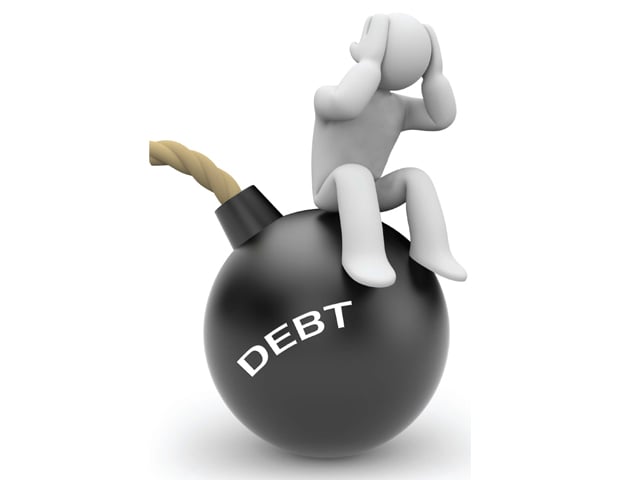

Those drafting the upcoming budget face a formidable set of challenges: the mammoth and still growing debt burden, the skyrocketing cost of living for the poor, and the seemingly intractable trade deficit, to name just a few.
But by far the biggest challenge is the mismatch between income and expenses. This has led the government to run a perennial budget deficit. Of course, this is a situation that cannot continue forever. If the government were a corporation, it would have been declared bankrupt years ago.
There are only two ways to address this problem: increase tax revenues or decrease expenses. On the latter, there's much the government can do to curb needless extravagance — think of the number of cabinet ministers it supports and their ancillary costs, or the number of MNAs and MPAs in our assemblies, whose presence or absence has zero impact on the country.
But ultimately, cutting expenses is a game of diminishing returns. You can trim the fat only so far before you get to the meat.
So, the solution to the budget deficit must rely on boosting revenues. And here lies the real problem. Pakistan is perhaps the only country in the world that gives its citizens the option to pay taxes — or not.
We have a whole category of people called non-filers who can legally refuse to be part of the tax net. Only a slim — and some might say foolish — minority has opted to become filers, actually submitting tax returns.
In an effort to improve tax compliance without broadening enforcement capacity, this filer versus non-filer distinction was introduced through the Finance Act 2013 under the Pakistan Muslim League-Nawaz (PML-N) government. It allowed the Federal Board of Revenue (FBR) to impose differential withholding tax rates on certain transactions — like vehicle registration, banking, and real estatebased on taxpayer status.
This had several goals: encouraging non-filers to register and become filers, using third-party withholding as a substitute for weak enforcement, and generating quick revenue from high-volume transactions.
Despite some early gains in revenue collection, the system created a host of negative consequences. It spawned a parallel economy which, rather than pushing non-filers into the formal system, effectively legalised non-compliance by allowing them to continue operatingalbeit at a higher cost.
Instead of enforcing mandatory return filing, the government began collecting advance taxes from non-filers on transactions such as vehicle registration, bank withdrawals, and real estate deals. This turned non-compliance into a revenue stream.
Many prefer to remain non-filers and simply absorb the higher withholding tax — it's often cheaper and less risky than formal registration. Cash-based and undocumented businesses continue to function outside the tax net, limiting the impact of broader economic reforms.
A particularly troubling outcome is that filers often feel punished for their honesty, while non-filers continue with impunity. Filers face politically motivated audits, complex filing requirements, and penalties for minor errors. Non-filers avoid scrutiny altogether. This disillusionment fosters cynicism and erodes trust in tax authorities.
Instead of encouraging compliance, the system paradoxically discourages it — especially when filers see no benefits in return for their transparency.
Tax systems thrive on fairness and reciprocity. Yet this two-tier structure undermines both. Filers rarely witness improvements in public services or infrastructure proportional to their contributions, further dampening their motivation to comply.
Knowing that non-compliance attracts no real penalty — beyond a slightly higher withholding rate — many make the rational decision to avoid filing. Certain sectors, like real estate and wholesale/retail trade, thrive despite being dominated by non-filers, making voluntary compliance appear naïve and burdensome.
This split also introduces market distortions. Individuals and businesses structure transactions to dodge higher non-filer taxesusing intermediaries, splitting invoices, or underreporting.
Genuine investors are deterred by sectors with high compliance burdens, creating a tilt toward low-visibility, low-regulation activities. Non-filers still invest in property— albeit at higher ratesfuelling speculation rather than productivity.
While withholding taxes have boosted collection, actual compliance and accountability remain weak. The government may celebrate rising revenues, but much of it comes from advance taxes on non-filers who remain beyond the system's reach.
There's been no expansion of the taxpayer base. Withholding doesn't equate to documentation or broader participation. Worse, the administrative burden has increased. Focusing on transaction-based tax grabs distracts from building institutional audit and enforcement capacity.
This system undermines progressive taxation. A core tenet of modern tax policy is that those who earn more should pay morea principle weakened by our current regime.
Withholding taxes are levied regardless of an individual's ability to pay, hitting poor and low-income non-filers hardest. Since non-filers are taxed per transaction, not income, the regime becomes regressive. Equity is eroded. The wealthiest often remain outside the net entirely by structuring their finances to avoid detection.
Finance Minister Muhammad Aurangzeb has called the upcoming budget a "structural budget" — implying fundamental reforms are on the table. If he truly intends to walk the talk, he must begin by scrapping the non-filer category. It's iniquitous and untenable.
But this alone won't suffice. The FBR's enforcement capacity must be enhanced to manage a larger filer base. Digitisation must also accelerate. Cashless, online transactions should be made mandatory. AI can automate many functions — like audit selection — that currently rely on human input.
These reforms will take time, but eliminating the non-filer status can happen immediately. It's the necessary first step, and it alone could significantly boost revenues and help reduce the chronic budget deficit that continues to haunt the country.
THE WRITER IS CHAIRMAN OF MUSTAQBIL PAKISTAN AND HOLDS AN MBA FROM HARVARD BUSINESS SCHOOL
Source link
