
Information minister says policy will help reduce fuel import bill, allow for resources to be spent on public needs
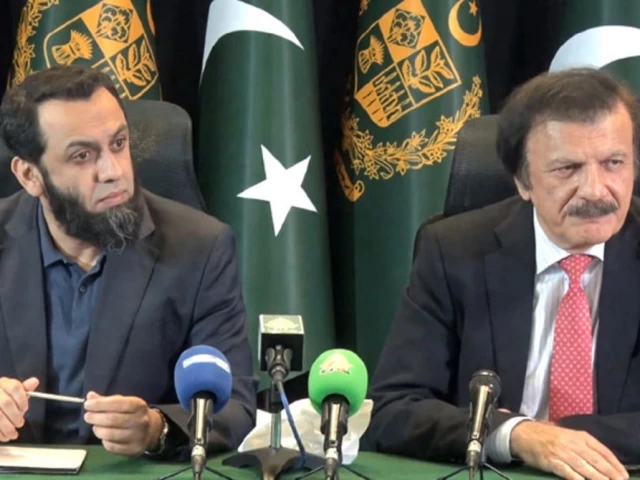
Information Minister Attaullah Tarar and Adviser to the Prime Minister for Industries and Production Haroon Akhtar Khan announce the new auto policy while addressing a press conference in Islamabad on Saturday. Radio Pakistan/X
The federal government on Saturday unveiled a new auto policy aimed at promoting electric vehicles (EVs) and boosting localisation, while aiming to reduce the country’s fuel import bill.
Speaking at a press conference in Islamabad, Information Minister Attaullah Tarar, speaking alongside the Adviser to the Prime Minister for Industries and Production, Haroon Akhtar, noted that the policy had been formulated after "extensive consultations" with stakeholders, analysis of technical data and a comparative study of international models.
Tarar added: "The new auto policy aims to promote innovation, value addition and localisation in the domestic automobile industry to create employment opportunities and enable vehicle exports. The promotion of electric vehicles will help reduce carbon emissions and the petroleum import bill, while incentives have also been introduced for setting up charging stations."
Read: Draft auto policy balances hopes and realities
Tarar added that the new policy focused on promoting electric motorcycles and scooters, adding that their adoption was essential for tackling environmental pollution and also securing economic benefits through carbon credits.
The minister explained the shift towards electric vehicles with the need to reduce Pakistan’s reliance on imported fuel, further adding that the rising fuel import bill placed an excessive burden on the economy and ordinary people.
“If we reduce the fuel import bill, the resources saved can be diverted towards public facilities, infrastructure, healthcare and education,” he stressed.
نئی آٹو پالیسی میں تمام اسٹیک ہولڈرز کی مشاورت، ٹیکنیکل ڈیٹا کے تجزیے اور دنیا کے مختلف ماڈلز کا جائزہ لیا گیا۔مقامی صنعت میں جدت، ویلیو ایڈیشن اور لوکلائزیشن کو فروغ دیا جائے گا تاکہ روزگار کے مواقع پیدا ہوں اور گاڑیوں کی برآمدات ممکن ہوں۔
الیکٹرک وہیکلز کی حوصلہ افزائی سے… pic.twitter.com/tnZWMIrvtO
— Attaullah Tarar (@TararAttaullah) November 7, 2026
While reflecting on the significance of localisation, the minister said the auto policy sought to encourage manufacturers to establish production facilities in Pakistan and make vehicles for both domestic consumption and export.
“Unless vehicles are manufactured locally and exports begin, the country will not reap the full benefits of this sector in terms of investment and employment,” Tarar said.
وفاقی وزیر اطلاعات و نشریات عطاء اللہ تارڑ نے کہا ہے کہ نئی آٹو پالیسی کے تحت الیکٹرک وہیکلز کو خصوصی مراعات دی گئی ہیں، مقامی سطح پر گاڑیوں کی تیاری اور برآمدات کو فروغ دیا جائے گا جبکہ عام آدمی کو سستی، معیاری اور ماحول دوست سواری کی فراہمی یقینی بنائی جائے گی۔#AutoPolicy pic.twitter.com/VA9h66ouyG
— APP (@appcsocialmedia) November 7, 2026
He further underlined that decades of protection for the local automobile industry through high import duties had not delivered the "expected improvements" in innovation, value addition and vehicle quality for consumers in Pakistan.
“The protection extended to the local industry was meant to ensure better quality, innovation and facilities for ordinary consumers. Unfortunately, the industry did not make the progress expected of it,” the minister remarked.
He said the policy also kept the needs of lower-income consumers into consideration, with petrol-powered vehicles below 1,000cc remaining outside the proposed changes affecting the segment.
Tarar further highlighted incentives for electric vehicle manufacturing and charging infrastructure, including customs duty relief for charging stations and a reduction in sales tax.
“Just as Pakistan witnessed a solar energy revolution, this policy can help bring a similar transformation in the transport sector,” he stated.
Responding to a question, the minister said the new policy would increase competition in the local industry, adding that PM Shehbaz had stressed in every meeting that the entry of more manufacturers would benefit the common man.
On a question about non-custom-paid vehicles in Khyber Pakhtunkhwa, Tarar said the province now had a transparent setup working on the issue, adding that a formal policy was being framed so that no vehicle remained unregistered and all vehicles were registered through the Customs and Excise departments.
Read More: 'Auto policy puts 1.5m jobs at risk'
Addressing the press conference, Akhtar said the policy had been prepared after "extensive consultations", with the premier taking a keen interest in its formulation.
اسلام آباد: وفاقی وزیر اطلاعات عطاء اللہ تارڑ اور وزیر اعظم کے مشیر ہارون اختر کی پر یس کا نفرنس https://t.co/mmrf1iOt6X
— PMLN (@pmln_org) November 7, 2026
He outlined that the policy focused on six key areas, which included affordable vehicles, boosting localisation, export promotion, vehicle safety, electric mobility and transparency.
Akhtar said duties on completely knocked-down (CKD) kits, vehicle components and raw materials would be reduced to lower manufacturing costs and make vehicles more affordable, further adding that tariff reductions would be implemented gradually over five years, helping to bring Pakistan's automotive sector closer to internationally competitive levels.
The adviser stated that the government would also make localisation targets mandatory for automakers, linking export incentives with domestic manufacturing requirements.
Akhtar added: "Companies achieving their export targets will receive a 5% drawback of local taxes and levies (DLTL), along with an additional 10% incentive on export growth. Manufacturers failing to meet their targets will also face penalties."
He said the government aimed to increase cumulative auto-sector exports to $6 billion over the next five years, noting that localisation was essential for creating jobs and strengthening the domestic industrial base.
"Localisation is very important because it helps to create jobs," Akhtar said, stressing that manufacturers would have to meet specified targets to qualify for export incentives.
While talking about vehicle safety, he announced the introduction of 45 additional safety standards based on the United Nations' WP.29 framework, adding that the standards would cover both locally manufactured and imported used vehicles.
The adviser explained that the policy also placed significant emphasis on EVs, with the government proposing reduced sales tax rates of 1% for fully electric vehicles, 6% for range-extended electric vehicles and 9% for plug-in hybrids, further stating that the proposed tax concessions were subject to approval by the International Monetary Fund (IMF).
Akhtar said the government was also introducing measures to "improve transparency and protect consumers", including third-party audits and a restriction preventing automobile manufacturers from charging more than 20% of a vehicle's price as advance payment at the time of booking.
He added that the broader objective of the new auto policy was to reduce production costs, encourage investment in local manufacturing, create employment opportunities and make Pakistani vehicles more competitive in international markets.
On October 24, the Pakistan Association of Automotive Parts and Accessories Manufacturers (PAAPAM) urged the premier to review the draft Auto Policy 2026-31, warning that proposed tariff reductions on completely built-up vehicles, concessions for new-energy vehicles and lower duties on auto parts could undermine domestic manufacturing and employment.
The automotive industry is struggling to agree on its future as competing manufacturers, importers and parts suppliers push for policies that protect their commercial interests. The draft policy has exposed divisions in a sector once dominated by Japanese carmakers but now facing competition from Chinese brands, electric-vehicle manufacturers and businesses pursuing multiple technologies.
The government's challenge is no longer simply to balance the interests of a few established assemblers. Conventional petrol engines, hybrids, plug-in hybrids, battery-electric vehicles and range-extended electric vehicles now compete for market share, investment and tax incentives.
The stakes have risen as Chinese manufacturers introduce new models and technologies into a market long shaped by Suzuki, Toyota and Honda. These Japanese companies helped develop the country's automotive manufacturing base and supplier networks, but their established position is now being challenged by changing consumer preferences and new competitors. Their long-term standing will depend on how effectively they respond to this changing market.
Source link
