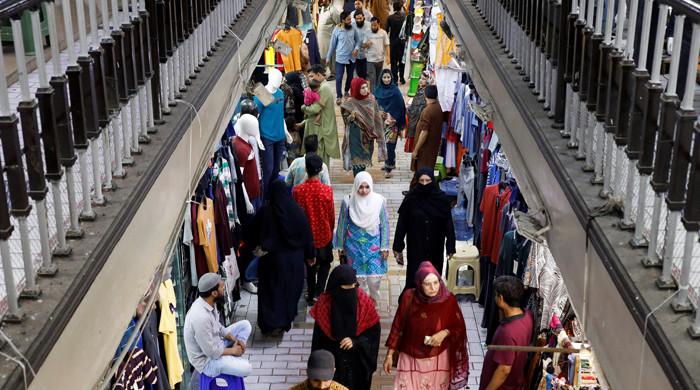

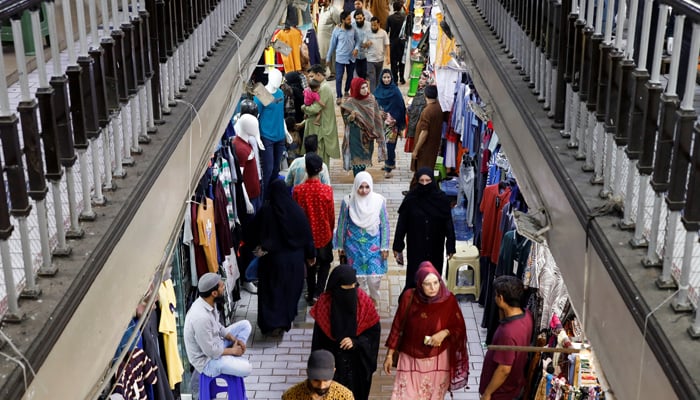
Pakistan, an important economy in South Asia, is anticipated to see modest growth and economic stabilisation in 2025, following a phase of contraction, with its GDP expected to rise by 2.3%, according to a United Nations report.
The report, titled ‘the UN World Economic Situation and Prospects 2025’, noted that declining inflation has allowed most of the South Asian region’s central banks to commence or continue monetary easing in 2025.
Meanwhile, governments in Pakistan, Bangladesh and Sri Lanka are expected to continue fiscal consolidation and economic reforms under International Monetary Fund (IMF)-supported programmes.
It said that the near-term outlook for South Asia is expected to remain robust, with growth projected at 5.7% in 2025 and 6.0% in 2026, “driven by strong performance in India as well as economic recovery in a few other economies”, including Bhutan, Nepal and Sri Lanka.
The report said the global economy is at a precarious juncture, marked by heightened trade tensions and elevated policy uncertainty. The recent surge in tariffs — driving the effective US tariff rate up steeply — threatens to raise production costs, disrupt global supply chains and amplify financial turbulence.
Uncertainty over trade and economic policies, combined with a volatile geopolitical landscape, is prompting businesses to delay or scale back critical investment decisions. These developments are compounding existing challenges, including high debt levels and sluggish productivity growth, further undermining global growth prospects.
Global GDP growth is now forecast at just 2.4% in 2025, down from 2.9% in 2024 and 0.4 percentage points below the January 2025 projection.
Slower global growth, elevated inflationary pressures and weakening global trade — including a projected halving of trade growth from 3.3% in 2024 to 1.6% in 2025 — jeopardise progress toward the Sustainable Development Goals.
The slowdown is broad-based, affecting both developed and developing economies. Growth in the United States is projected to decelerate significantly, from 2.8% in 2024 to 1.6% in 2025, with higher tariffs and policy uncertainty expected to weigh on private investment and consumption. In the European Union, GDP growth is forecast at 1.0% in 2025, unchanged from 2024, amid weaker net exports and higher trade barriers.
China’s growth is expected to slow to 4.6% this year, reflecting subdued consumer sentiment, disruptions in export-oriented manufacturing and ongoing property sector challenges. Several other major developing economies, including Brazil, Mexico and South Africa, are also facing growth downgrades due to weakening trade, slowing investment and falling commodity prices. India, whose 2025 growth forecast has been revised downward to 6.3%, remains one of the fastest growing large economies.
“The tariff shock risks hitting vulnerable developing countries hard, slowing growth, slashing export revenues, and compounding debt challenges, especially as these economies are already struggling to make the investments needed for long-term, sustainable development,” said United Nations Under-Secretary-General for Economic and Social Affairs Li Junhua.
While global headline inflation eased from 5.7% in 2023 to 4.0% in 2024, price pressures remain stubbornly high in many economies. By early 2025, inflation exceeded pre-pandemic averages in two-thirds of countries, with over 20 developing economies facing double-digit rates.
Food inflation, averaging above 6%, continues to hit low-income households hardest, particularly in Africa, South Asia and Western Asia. Higher trade barriers and climate shocks are further amplifying inflation risks, underscoring the need for coordinated policies — combining credible monetary frameworks, targeted fiscal support and long-term strategies — to stabilise prices and shield the most vulnerable.
In many countries, monetary policy challenges have intensified in an uncertain economic environment. Central banks are grappling with difficult trade-offs between managing inflationary pressures — exacerbated by tariff-induced price shocks — and supporting slowing economies. At the same time, limited fiscal space, especially in developing economies, constrains governments’ ability to effectively mitigate the economic slowdown.
Deteriorating global prospects and geopolitical fragmentation undermine development progress.
For many developing countries, this bleak economic outlook undermines prospects for creating jobs, reducing poverty, and addressing inequality. For least developed countries — where growth is expected to slow from 4.5% in 2024 to 4.1% in 2025 — declining export revenues, tightening financial conditions and reduced official development assistance flows threaten to further erode fiscal space and heighten the risk of debt distress.
Escalating trade frictions are further straining the multilateral trading system, leaving small and vulnerable economies increasingly marginalised in a fragmented global landscape.
Strengthening multilateral cooperation is essential to address these challenges. Revitalising the rules-based trading system and providing targeted support to vulnerable countries will be critical to fostering sustainable and inclusive development.
The Fourth International Conference on Financing for Development, taking place in Sevilla, Spain, from June 30 to July 3, 2025, will be a crucial platform to address issues such as strengthening multilateral cooperation, debt sustainability and more to drive concrete actions on financing for sustainable development for all, the report added.
Source link
